
An LT panel sits at the heart of every factory, hospital and commercial building. Once it is installed, it runs for 20 years or more, so a poor choice of panel builder shows up as nuisance trips, hot busbars and shutdowns long after the invoice is paid. If you are buying an electrical panel, these are the points to check before you place the order.
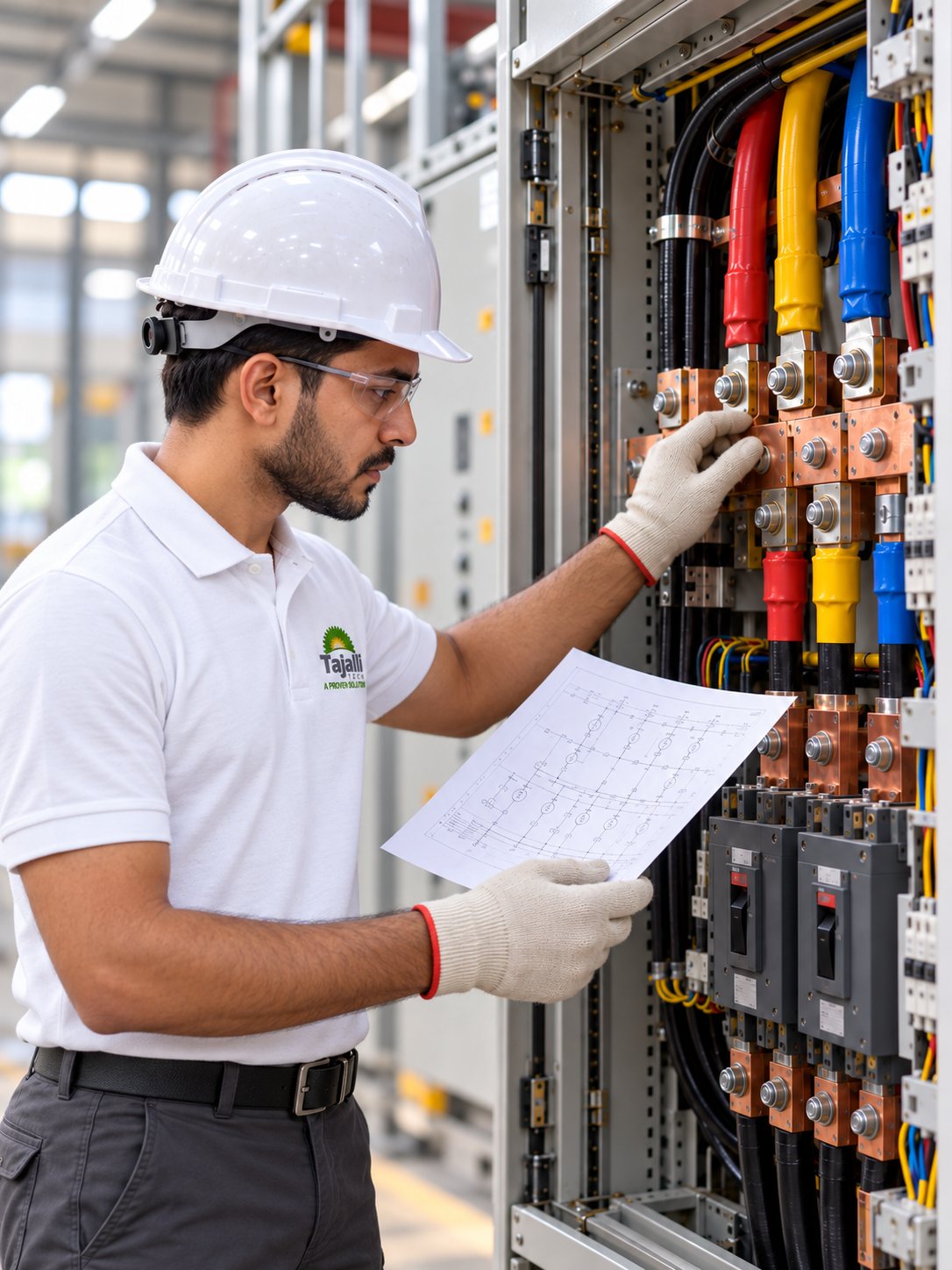
1. Start with the single line diagram, not the price
A good panel builder asks for your load list and gives you a single line diagram (SLD) before quoting. The SLD shows the incomer rating, every outgoing feeder, the breaker type for each, and the busbar rating. If two quotes are built on different SLDs, you are not comparing like with like. Ask every supplier to quote against the same SLD.
2. Check the busbar size and material
Busbars carry the full load of the panel. Ask for the busbar size, whether it is copper or aluminium, and the current density it was sized for. Undersized busbars are one of the most common ways a cheaper panel saves money, and one of the most common causes of hot spots we find during thermography.
3. Ask which breakers, relays and meters are used
- Incomer: an ACB or MCCB of a known make, with the right breaking capacity for your transformer and fault level.
- Outgoings: MCCBs or MCBs rated for each feeder, not one size used everywhere.
- Protection and metering: earth fault and overload protection where needed, and a multifunction meter on the incomer.
- Power factor correction: if your bill shows a low power factor, an APFC panel with the right kVAr and detuned reactors where harmonics are present.
Get the makes and ratings written into the quotation, so they cannot be swapped at delivery.
4. Look at the enclosure and the layout
Sheet thickness, powder coating, IP rating for the location, cable entry from top or bottom, and enough space inside for cables to be terminated properly all matter. A cramped panel is hard to maintain and runs hotter.
5. Insist on tests before dispatch
Before the panel leaves the workshop, it should be tested and the results recorded: insulation resistance of the busbars and wiring, high-voltage withstand, control wiring checks, and a functional test of breakers, interlocks and meters. Ask to see the test report, or to witness the test.
6. Ask who will install, test and maintain it
The panel is only as good as its installation. Earthing, cable termination torque, and commissioning tests on site all affect how it performs. A supplier who can also install, commission and later maintain the panel under an AMC removes the finger-pointing when something goes wrong.
Quick checklist
- Same SLD used for every quote
- Busbar size and material stated in writing
- Breaker, relay and meter makes and ratings listed
- Enclosure thickness, coating and IP rating stated
- Routine test report before dispatch
- Installation, commissioning and AMC covered
Need a panel for your plant or building?
Tajalli Tech designs, supplies, installs and tests electrical panels in Lucknow and across Uttar Pradesh, including LT and HT panels, APFC panels and distribution boards. Our team also handles electrical installation and thermography of existing panels. Send us your load list or SLD, or call 0522-4956473, and we will suggest the right panel and ratings.
Questions
What is the difference between an LT panel and an HT panel?
An LT panel works at low voltage, usually 415 V, and distributes power inside a building or plant. An HT panel works at 11 kV or 33 kV and sits on the incoming supply before the transformer.
How long does it take to build an LT panel?
It depends on the size and the availability of breakers, but most standard LT panels take a few weeks from approved drawing to dispatch.
Should busbars be copper or aluminium?
Both are used. Copper is more compact for the same current; aluminium is lighter and cheaper but needs a larger section. What matters is that the size matches the current and is stated in the quotation.
Can you test or upgrade our existing panel?
Yes. We test, service and upgrade existing panels, including replacing old breakers and adding power factor correction.