
In an operation theatre, a power cut is not an inconvenience. If the supply to a patient monitor, an anaesthesia machine or an infusion pump trips in the middle of surgery, the surgical team has a problem that no generator can solve in time. That is why hospitals use a medical isolated power system, also called a medical IT system, in operation theatres, ICUs and other critical rooms.
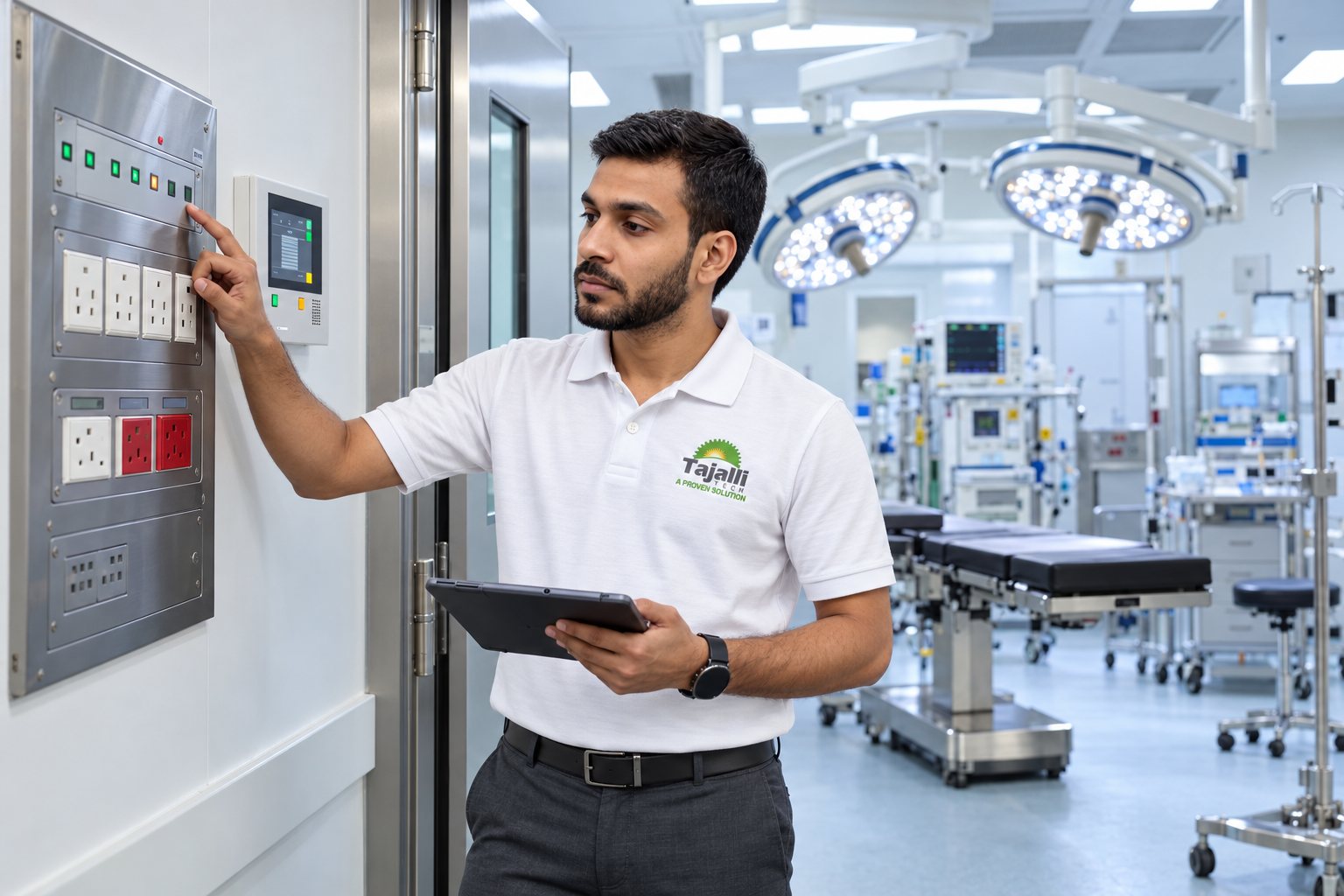
This article explains what the system does, what is inside a medical isolation panel, and what to check when you build a new OT or ICU or upgrade an old one.
The problem with a normal supply in an OT
Most buildings use an earthed supply. If a live wire touches an earthed metal part, a large fault current flows, the MCB or RCCB trips, and the circuit goes dead. In an office that is exactly what you want.
In an operation theatre it is not. The first earth fault on a circuit, perhaps a damaged cable on a surgical light or moisture in a socket, would switch off every piece of equipment on that circuit, during surgery.
How a medical isolated power system solves it
A medical IT system feeds the critical room through an isolation transformer. The secondary side is not connected to earth. If one conductor develops a fault to earth, very little current can flow, so nothing trips and the equipment keeps running.
At the same moment, an insulation monitoring device (IMD) detects that the insulation has dropped and raises an alarm. The OT staff see and hear the alarm on a panel in the room. The surgery continues safely, and the fault is found and repaired afterwards, when it can be done without risk to the patient.
The simple way to remember it: an ordinary system trips on the first fault, a medical IT system warns on the first fault.
Where it is needed
The international standard for electrical installations in medical locations, IEC 60364-7-710, divides hospital rooms into groups. Group 2 rooms are those where a power interruption can put a patient’s life at risk, and where equipment is used for procedures such as surgery or life support. These rooms need a medical IT system. In practice this covers:
- Operation theatres, including modular OTs and gynaecology OTs
- Cardiac catheterisation labs
- ICU, ICCU, NICU and MICU beds
- Post-operative and recovery rooms
- Emergency resuscitation areas
What is inside a medical isolation panel
A medical IPS panel is more than a transformer in a box. A complete system usually includes:
- Medical isolation transformer built for low leakage and low inrush current
- Insulation monitoring device that continuously measures the insulation resistance of the isolated supply
- Load and temperature monitoring of the transformer, so an overload is flagged before it becomes a trip
- Remote alarm and indicator panel inside the OT or ICU, with audible and visual alarms and a test button
- Distribution with MCBs for each outgoing circuit to the pendants, sockets and equipment
This combination is what gives the theatre team power distribution monitoring: they can see at a glance that the supply is healthy, and they are warned early when it is not.
Mistakes we see on site
- The alarm panel is fitted where no one can see or hear it. It should be inside the room, in the staff’s line of sight.
- The system is never tested after handover. The IMD and alarms should be tested at regular intervals, and the results recorded.
- Non-critical loads are put on the isolated supply. Room lighting, air conditioning and general sockets belong on the normal and emergency supply, not on the IT system.
- Earthing and equipotential bonding are poor. A medical IT system works with good equipotential bonding in the room, not instead of it.
Testing an existing system
If your hospital already has medical IT panels, they should be checked periodically. A proper test covers the insulation monitoring device and its alarm threshold, the remote alarm panels, the transformer load and temperature monitoring, and the earthing and bonding of the room. You should receive a written test report you can show an assessor.
Planning a new OT or ICU?
Tajalli Tech supplies, installs and tests medical IT isolated power systems for hospitals in Lucknow and across Uttar Pradesh. Share the number of OTs, ICU beds and the equipment you plan to use, and we will suggest the right panels and transformer ratings. Call 0522-4956473 or send an enquiry.
Questions
What is a medical isolated power system?
It is a supply fed through an isolation transformer with no connection to earth on the secondary side. A first earth fault does not trip the circuit. Instead, an insulation monitoring device raises an alarm, so critical equipment keeps running.
Is a medical IT system the same as a UPS?
No. A UPS keeps power on when the mains fails. A medical IT system keeps power on when an earth fault occurs. Critical rooms often need both.
Which hospital rooms need a medical IT system?
Group 2 medical locations under IEC 60364-7-710, such as operation theatres, cath labs, ICUs and other rooms where a power interruption can put a patient’s life at risk.
Can you test our existing medical IT panels?
Yes. We test the insulation monitoring device, alarms, transformer monitoring and room earthing, and give a written report.